


A TRUE TALE WITH
A CHERRY ON TOP

Red Comet Press
(pub. 3.11.2026)
48 pages
Ages 7 -11
Author: Mia Wenjen
Illustrator: Violeta Encarnación
Characters: Two girls. Eighty years apart.
One from a Japanese internment camp.
One as a contemporary U.S. migrant.
Overview:
" Barbed Wire Between Us is a powerful reverso poem that tells two deeply resonant stories across time. It begins with a Japanese American girl sent to an internment camp in Oklahoma during World War II. Read in reverse, it reveals the journey of a Latina girl detained in the very same camp decades later, during the U.S. policy of migrant family separation."
Tantalizing taste:
"In this land of promise, we hoped to find a place to belong.
To our surprise, we were unjustly imprisoned.
We came with only what we could carry.
...
To our surprise, we were unjustly imprisoned.
We came with only what we could carry.
In this land of promise, we hoped to find a place to belong."
And something more: The Setting in the Back Matter explains: "Set in Fort Sill, north of Lawton and about eighty-five miles southwest of Oklahoma City, this army base served as one of more than seventy internment camps, housing approximately seven hundred Japanese Americans during World War II.
Starting in 2014, Fort Sill served as an immigrant detention center for children. It is this parallel that serves as the setting for this book."
Mia Wenjen shared in the Author's Note: "My mother was born in San Francisco's Japantown, making her and her siblings US citizens. Her parents emigrated from Hiroshima, Japan. After the Japanese bombed Pearl Harbor on December 7, 1941, Japanese Americans were forced into prison camps known as internment camps. My mother and her family were fortunate. They had relatives living in a remote part of Utah and relocated there. Still, life was hard. For more than four years, they lived in a tent and worked as farm laborers. My mother rarely talked about her years in Utah. I only remember her saying that there were times that her family would joke that they would have been better off at a concentration camp."
The True Story of Maria Pepe
and her Battle to Play Ball

A TRUE TALE WITH
A CHERRY ON TOP
Christy Ottaviano Books
(Little Brown and Company)
(pub. 3.3.2026)
48 pages
Ages 6 - 8
Author: Maria Pepe & Jean L.S. Patrick
Illustrator: Sarah Green
Character: Maria Pepe
Overview:
" Maria Pepe loved baseball. When Little League formed in her hometown in 1972, she was eager to prove herself as a competitor. There was only one problem: Little League was not open to girl players. This didn’t stop Maria. She took her glove and joined her friends, Nicky and Louie, at tryouts. She could hit, pitch, and catch as good as any of the boys—better than many, even, and it was no surprise that Maria made the team. Little did she know, she would make history when the Little League officials refused to let her play because she was a girl."
Tantalizing taste:
"On November 7, 1973, hearing officer Sylvia Pressler announced her decision.
Girls must be allowed to participate in Little League.
"The institution of Little League is as American as the hot dog and apple pie,' she stated. 'There's no reason why that part of Americana should be withheld from girls.'"
And something more: Note from Maria Pepe shares: "My personal experience with discrimination at such a young age did not deter me from playing sports... Participating in sports helped me both professionally and personally to appreciate the importance of teamwork, winning and losing, and so much more. These are the values that Little League has as its mission...
"It has been over fifty years since I stepped onto the pitcher's mound in Hoboken and the 1974 court ruling that followed, and I have come full circle... I still live in Hoboken, where the batting cages at the Little League field are named after me. Currently, I dedicate my time and support to encouraging girls to follow their passions and believe in themselves. The best part of all is the privilege of watching girls play baseball and participate in the sport I love."
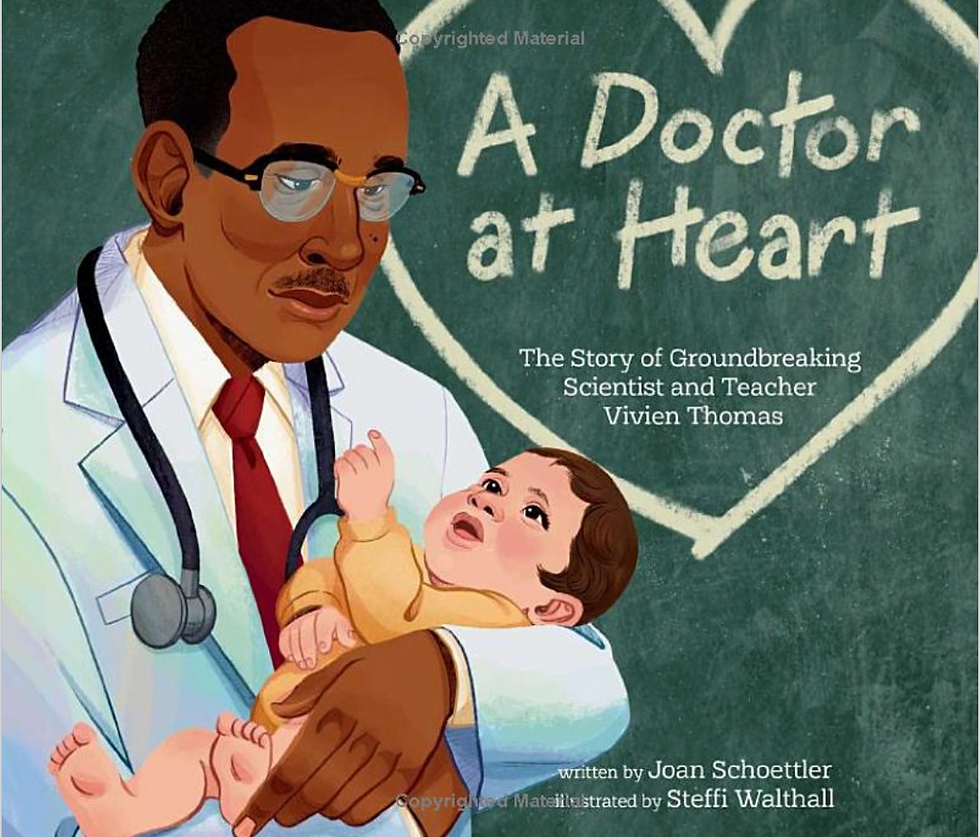
The Story of Groundbreaking Scientist
and Teacher Vivien Thomas
A TRUE TALE WITH
A CHERRY ON TOP
Beach Lane Books
(Simon & Schuster)
(pub. 5.12.2026)
48 pages
Ages 4 - 8
Author: Joan Schoettler
Illustrator: Steffi Walthall
Character: Vivien Thomas
Overview:
" Vivien Thomas always loved solving problems and figuring out how things worked. In high school, inspired by his family physician, he decided he would become a doctor. Despite losing his college savings during the 1930 bank panic, Vivien stayed dedicated to making his dream a reality, a trait that would serve him all his life.
Vivien secured a lab assistant position at Vanderbilt University and later moved to Johns Hopkins Hospital, where he and his mentor developed a groundbreaking procedure to cure blue baby syndrome, which led to them performing the first open-heart surgery on a child."
Tantalizing taste:
"Many surgeons learned how to perform the blue baby surgery under Vivien's guiding hands.
One day, Dr. Blalock examined an almost invisible line of stitches.
'Vivien, are you sure you did this?' asked Dr. Blalock.
Vivien nodded.
'This looks like something the Lord made,' said Dr. Blalock.
Yet Vivien's pay stayed low. Though he kept working in the lab, he took other jobs to supplement his income. Sometimes he was a bartender at house parties, where he served the people he worked with during the day at Johns Hopkins.
Meanwhile, Vivien taught many young medical practitioners who would go on to become some of the top cardiac surgeons in the country."
And something more: Joan Schoettler shared in the Author's Note: "After I watched Something the Lord Made, a film about Vivien Thomas (1910-1985), the idea to write a picture book for young readers about this inspiring man took hold. Thomas overcame challenges, disappointments, and racial bias to become a researcher, teacher and medical-device inventor. Along the way, he helped develop modern heart surgery... "
"Thomas's students remembered him saying, 'Everybody's got a job to do. You are put here to do a job one hundred percent, regardless of how much education you have.' Vivien Thomas held those words close throughout this life, and he lived them to the fullest."
